




Injection Molding Cycle Time Drops for the Wrong Reasons




Why does injection molding cycle time sometimes drop for the wrong reasons? The short answer is that a faster cycle is not always a real productivity gain. In many molding operations, cycle time falls because the process window has been pushed too hard, cooling has been cut too short, material behavior has changed, or quality checks have not yet captured the damage. For technical evaluators, sourcing teams, project managers, and business decision-makers, the key question is not “Did the cycle get shorter?” but “What exactly was sacrificed to make it shorter, and what will that cost later?”
In polymer processing, especially where recycled plastics, cost pressure, energy efficiency targets, and supply-chain volatility are all in play, an apparently better cycle can conceal higher scrap, more warpage, unstable dimensions, weaker mechanical properties, tool wear, customer complaints, or compliance risk. A lower cycle time only creates value when part quality, material integrity, equipment stability, and total delivered cost remain under control.
When a shorter injection molding cycle time is actually a warning sign
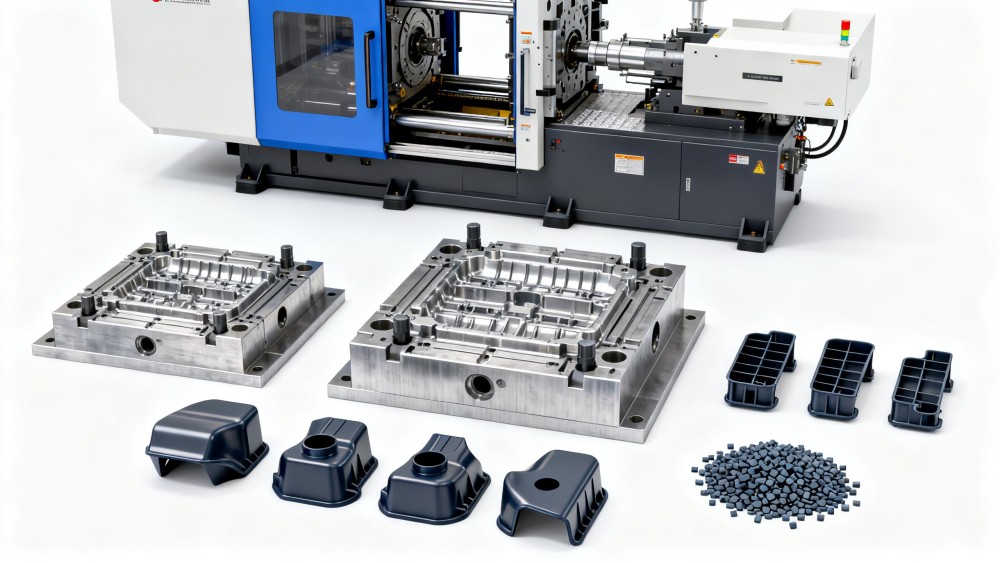
For many buyers and plant teams, cycle time is treated as a headline KPI because it directly affects output, machine utilization, and quoted part cost. That is reasonable—but incomplete. A cycle time reduction becomes dangerous when it is achieved by removing necessary process stability rather than eliminating waste.
In practice, cycle time may drop for the wrong reasons when:
- Cooling time is reduced below what the polymer truly needs, causing internal stress, post-mold shrinkage, dimensional drift, sink marks, or warpage.
- Holding or packing time is cut too aggressively, leading to inconsistent mass, voids, poor surface finish, and lower structural reliability.
- Melt temperature or mold temperature is shifted simply to speed release, even if that change worsens crystallinity, surface quality, or mechanical performance.
- Regrind or recycled resin ratio changes alter flow behavior and cooling response, making the shorter cycle look acceptable in the short term while increasing variability lot to lot.
- Ejection happens too early, causing part deformation that may only appear after storage, transport, or assembly.
- Maintenance is deferred, so the process appears faster only because tooling wear, venting issues, or cooling imbalance have not yet been addressed.
This is why smart operators and evaluators separate real cycle time optimization from false cycle compression. Real optimization preserves process capability. False compression pushes hidden defects downstream.
What target readers usually need to verify before accepting a “faster” process
Different stakeholders view injection molding cycle time through different lenses, but their concerns often converge around risk, cost, and reliability.
Technical assessment teams want to know whether the process remains statistically stable. A shorter cycle means little if Cp/Cpk worsens, dimensional consistency falls, or test data become less repeatable.
Procurement and commercial teams want to know whether a supplier’s lower piece price is based on sustainable efficiency or on hidden quality risk. A quote built on unrealistic cycle assumptions can collapse later into claims, delays, and requalification costs.
Quality and safety managers focus on whether the shortened cycle affects mechanical strength, chemical resistance, sealing performance, flame performance, or long-term durability—especially for industrial, automotive, electrical, or pressure-related parts.
Project managers and decision-makers care about throughput, energy consumption, tooling life, complaint exposure, and the total cost of ownership across the product lifecycle.
Financial approvers need to understand whether the reported gain is a genuine productivity improvement or a fragile shortcut that creates hidden liabilities later.
In other words, the most useful question is not whether the machine runs faster today, but whether the full operating system—material, mold, process, inspection, logistics, and field performance—still works reliably.
Why material changes often sit behind suspicious cycle time reductions
In today’s polymer market, material substitution is common. Resin cost swings, recycled content targets, carbon reduction pressure, and regional supply-chain constraints all influence material choice. That makes cycle time analysis more complex than many dashboards suggest.
A shorter cycle can appear after switching materials, but the reason may not be healthy process improvement. Consider several common scenarios:
- Lower-viscosity resin flows more easily, reducing fill difficulty and apparent cycle time, but may increase flash risk or alter final part strength.
- Higher recycled content changes thermal behavior, reducing consistency in cooling and shrinkage from batch to batch.
- Different additives or fillers improve release or speed solidification, but may affect impact resistance, weld line strength, appearance, or compliance status.
- Moisture-sensitive materials may process quickly at first, while inadequate drying later causes hydrolysis, brittleness, or surface defects.
For industries dealing with engineering plastics, commodity polymers, or circular economy sourcing, this matters greatly. A process validated on virgin resin may behave very differently with post-industrial or post-consumer recycled plastics. A lower cycle time under one lot condition does not automatically translate into stable industrial production.
This is especially relevant when companies are balancing sustainability goals with product performance. Reducing cycle time and increasing recycled content can both look positive in reporting, but if they jointly reduce quality margin, the business case weakens quickly.
How to tell the difference between true efficiency and hidden downstream cost
A useful evaluation framework is to compare machine-side gains with system-wide consequences. If cycle time drops by 8%, but scrap rises, inspection tightens, and returns increase, the plant is not truly more efficient.
Use the following checkpoints:
- Part weight stability: Has part weight become more variable after the cycle reduction? This often signals packing or cooling problems.
- Dimensional stability over time: Do parts pass immediately after molding but drift after 24 to 72 hours?
- Mechanical property validation: Were tensile, impact, pressure, fatigue, or assembly tests repeated after the new cycle was introduced?
- Scrap and rework rate: Did hidden internal rejects rise even if shipped defect rate has not yet changed?
- Tooling and maintenance burden: Has mold sticking, vent contamination, ejector wear, or thermal imbalance increased?
- Energy per good part: A faster cycle is not always more energy efficient if rejects rise or secondary handling increases.
- Customer complaint lag: Some failures appear only after shipping, storage, assembly, or field use.
Decision-makers should insist on good-part economics, not just machine-cycle economics. The right metric is cost per conforming part delivered to customer requirement, not simply shots per hour.
Where cycle time cuts create the biggest commercial and compliance risk
Not every molded product carries the same risk profile. For simple non-critical packaging or low-load consumer items, a modest cycle reduction may be commercially acceptable if quality remains within defined tolerance. But in more demanding applications, the risk is much higher.
Be especially cautious when the molded part is used in:
- automotive structural or under-hood environments
- electrical insulation or connector systems
- industrial fluid handling or chemical exposure settings
- medical-adjacent or hygiene-sensitive components
- precision assemblies requiring tight dimensional repeatability
- parts made from filled, reinforced, or flame-retardant compounds
In these cases, an unjustified cycle time reduction can become a compliance issue, a warranty issue, or a brand-risk issue. What looks like a processing improvement may actually compromise validated product performance. For procurement teams and distributors, this is where supplier claims must be tested carefully, not accepted at face value.
How plant teams can reduce cycle time for the right reasons
The goal is not to avoid cycle time reduction. The goal is to achieve it through robust engineering. Sustainable cycle time improvement usually comes from process understanding, not from simply removing seconds.
The most reliable levers include:
- Cooling system optimization: Improve channel design, flow balance, heat transfer efficiency, and mold thermal control.
- Mold design refinement: Address venting, gate location, wall thickness balance, and ejection design.
- Material-specific processing windows: Optimize based on real resin behavior, including recycled-content variation where relevant.
- Scientific molding methods: Use cavity pressure, transfer position control, gate seal analysis, and decoupled process setup.
- Drying and handling discipline: Especially important for hygroscopic polymers and mixed-lot supply conditions.
- In-line quality monitoring: Detect instability before defects move into inventory or customer shipments.
- Total value validation: Confirm that lower cycle time also protects yield, mechanical performance, and downstream assembly behavior.
For enterprises under carbon and energy pressure, it is worth noting that true process optimization can support both productivity and sustainability. But false optimization often does the opposite: it creates waste, rework, transport inefficiency, and avoidable material loss.
Questions buyers and executives should ask when a supplier reports lower cycle time
If a supplier claims a significantly improved injection molding cycle time, the response should be commercial curiosity combined with technical discipline. The following questions help separate credible operational excellence from hidden risk:
- What process parameter changes created the cycle reduction?
- Was the material grade, recycled content, additive package, or drying standard changed?
- What before-and-after data exist for dimensional stability, part weight, scrap, and customer-critical properties?
- Were mold temperature, cooling conditions, and ambient conditions equivalent during comparison?
- Has the new cycle been proven across multiple lots, operators, and production durations?
- What is the impact on energy per good part and on preventive maintenance intervals?
- Was the result validated only at machine level, or at shipment and field-performance level too?
These questions are especially valuable for cross-functional reviews involving engineering, sourcing, quality, and finance. They prevent organizations from approving “savings” that later reappear as quality cost, delivery instability, or reputational damage.
Conclusion: a lower cycle time is only valuable when the whole system improves
Injection molding cycle time drops for the wrong reasons when speed is achieved by borrowing against quality, material stability, tooling life, or downstream reliability. That kind of improvement is not efficiency—it is deferred cost.
For heavy industry stakeholders, polymer processors, sourcing teams, and enterprise decision-makers, the right conclusion is clear: treat shorter cycle times as a claim that must be validated, not a benefit that can be assumed. Real process excellence means lower cycle time and stable quality, controlled material behavior, acceptable compliance risk, and better total economics.
In a market shaped by commodity fluctuation, recycled plastics adoption, energy transition, and stricter operational accountability, the smartest metric is not how fast a mold opens. It is how reliably the business converts raw material into conforming, profitable, low-risk products over time.
Related News
- Injection molding innovations worth adopting in 2026Apr 28, 2026Injection molding innovations for 2026: adopt circular economy polymers, low-carbon material utilization, and sustainable energy materials to support carbon neutral industry goals, compliance, and resilient growth.
- Injection molding innovations that cut scrap ratesApr 28, 2026Injection molding innovations cut scrap with smarter tooling, process control, and circular economy polymers—supporting low-carbon material utilization and carbon neutral industry goals.
- When Injection Molding Defects Point to a Material IssueApr 28, 2026Injection molding defects may signal polymer materials risk, not process error. Learn how recycled plastics, heavy industry, and carbon neutrality goals affect sourcing, compliance, and part quality.
- Injection Molding Cycle Time Drops for the Wrong ReasonsApr 28, 2026Injection molding cycle time can drop for the wrong reasons. Learn how recycled plastics, polymer materials, and carbon neutrality pressures affect quality, cost, and heavy industry risk.
Related News
- 00
0000-00
Agrochemical regulations: common export compliance mistakes - 00
0000-00
Circular economy polymers: how to avoid quality issues - 00
0000-00
Circular economy polymers: virgin or recycled blends? - 00
0000-00
Bio-based materials still face a performance trust gap - 00
0000-00
Industrial decarbonization targets slip when baselines are weak
Weekly Insights
Stay ahead with our curated technology reports delivered every Monday.