



Circular economy polymers: virgin or recycled blends?




As circular economy polymers move to the center of industrial strategy, the choice between virgin resin and recycled blends is becoming a critical question for manufacturers, buyers, and technical teams. Within the global energy matrix, this debate affects low-carbon material utilization, injection molding innovations, compliance, performance, and long-term value across today’s carbon neutral industry.
For procurement teams, the issue is no longer whether recycled content should be considered, but how much can be introduced without creating process instability, customer complaints, or compliance gaps. For technical evaluators and quality managers, the challenge is balancing melt flow, impact strength, odor, contamination risk, and traceability across different supply batches.
For decision-makers in polymer-intensive sectors, the virgin-versus-recycled question also sits inside a broader commodity logic. Feedstock volatility, carbon reporting, trade compliance, and downstream product claims now influence resin selection as much as pure material cost. In this environment, the most resilient strategy is rarely ideological. It is application-specific, data-based, and supply-chain aware.
Why the Virgin vs Recycled Blend Decision Has Become Strategic
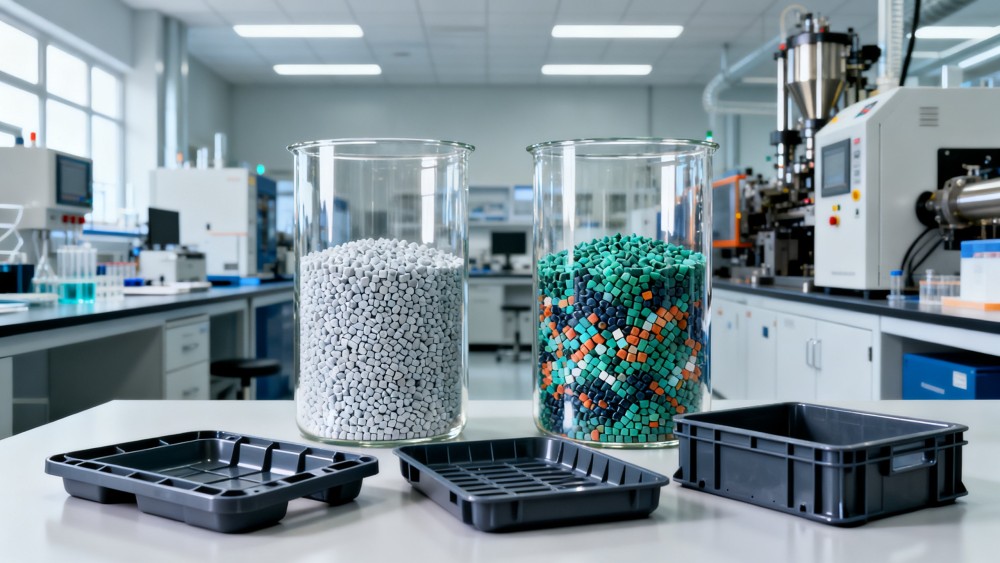
Circular economy polymers have moved from a sustainability topic to a board-level sourcing decision because polymers now sit at the intersection of cost control, carbon reduction, and product compliance. In many industrial categories, resin can represent 35%–70% of the material bill of a molded or extruded part, so small changes in formulation can materially affect margin, scrap rate, and customer acceptance.
Virgin polymers still offer the clearest baseline for consistency. They typically provide tighter control on melt flow index, color, mechanical performance, and contamination levels. For critical applications with thin-wall molding, high cosmetic requirements, or repeated mechanical stress, that consistency reduces risk during production runs of 10,000 to 1,000,000 parts.
Recycled blends, however, are becoming commercially attractive for at least 4 reasons: lower embodied carbon, improved access to customers with recycled content targets, reduced exposure to virgin feedstock spikes, and stronger alignment with emerging procurement policies. In some sectors, buyers now request 10%–50% recycled content in non-food-contact components as part of annual supplier qualification.
The practical question is not whether recycled polymers are viable in principle. It is whether a given blend ratio is compatible with the required process window, compliance obligations, and field-life expectations. A 15% recycled blend may work well in transport packaging, while a 40% blend may be acceptable in non-visible technical housings, but neither assumption should be transferred automatically across applications.
Three forces changing buyer behavior
- Commodity volatility: polymer feedstock pricing can shift within 30–90 days, changing the economics of virgin-only sourcing.
- Customer requirements: OEMs and brand owners increasingly ask for recycled content declarations, carbon data, and batch traceability.
- Regulatory scrutiny: documentation, restricted substance control, and claim substantiation have become more important than broad sustainability language.
These forces explain why GEMM-style market intelligence matters. The material decision now depends on upstream energy trends, polymer recovery quality, and regional trade compliance, not only on nominal resin price per kilogram.
How Virgin Resin and Recycled Blends Differ in Industrial Performance
Performance comparison must begin with application conditions. A polymer blend that performs well in a warehouse crate at 20°C may fail in an under-hood component exposed to 80°C–120°C, oils, vibration, and continuous stress. Material choice therefore needs to reflect actual operating environments rather than generic sustainability goals.
Virgin resin usually delivers narrower batch-to-batch variation. In injection molding, that can mean more predictable fill pressure, cycle time stability, and lower defect rates. Recycled blends may introduce wider variation in moisture, ash content, gels, black specks, or residual odor, especially when the feedstock source changes across post-industrial or post-consumer streams.
That said, modern compounding has improved the performance ceiling of recycled blends. With proper sorting, filtration, compatibilizers, and additive packages, many industrial users can achieve stable output in selected applications at 20%, 30%, or even 50% recycled content. The key is to validate not only tensile properties but also processing behavior over at least 3 pilot batches.
Typical comparison factors for evaluation teams
The table below summarizes how technical and commercial teams often compare virgin polymers with recycled blends in industrial procurement and process qualification.
The main takeaway is that neither option is universally better. Virgin material is usually the safer choice when tolerance for variability is low. Recycled blends become highly competitive when applications can absorb moderate property variation and when supply partners can provide robust quality documentation.
Common process signals to monitor
- Melt flow drift greater than 10% between lots may indicate unstable feedstock composition.
- Moisture-sensitive polymers may require drying windows of 2–4 hours before molding.
- Visual reject rates above 1.5%–3% often justify reformulation or tighter incoming inspection.
Selecting the Right Blend Ratio by Application, Risk, and Compliance
The most effective approach is to choose blend ratios by risk class rather than by broad corporate target alone. A plant that uses one recycled-content rule across all SKUs can create hidden failures. Instead, materials should be grouped into at least 3 categories: critical structural parts, functional but non-safety parts, and non-critical packaging or logistics components.
For highly visible consumer-facing surfaces, technical teams often begin with 0%–15% recycled content to protect appearance and color uniformity. For internal housings, trays, bins, pallets, and transport items, 25%–60% may be feasible if odor, dimensional stability, and impact resistance remain within specification. For regulated or safety-critical uses, recycled content must be reviewed against all material declarations and end-use restrictions before approval.
Procurement teams should also check whether the recycled stream is post-industrial or post-consumer. Post-industrial material often offers better consistency and lower contamination risk. Post-consumer streams may provide stronger circularity claims but can require more aggressive sorting and testing. That difference affects not only performance but also documentation burden, customer communication, and acceptable claim language.
Decision framework for buyers and engineers
A structured selection matrix helps cross-functional teams compare options before moving into plant trials.
This kind of matrix reduces internal conflict between sustainability goals and factory realities. It also gives procurement a practical basis for supplier comparison, especially when two materials have similar pricing but different quality assurance depth.
Four approval questions every team should ask
- What is the maximum acceptable property loss versus the virgin benchmark, for example 5% or 10%?
- How many lots should be tested before release: 1 lab batch, 3 pilot lots, or 1 full production month?
- What customer claims can be supported by documentation without overstatement?
- What is the contingency plan if recycled feedstock quality shifts within a 60-day sourcing cycle?
Supply Chain, Cost, and Quality Control in Circular Polymer Procurement
In many cases, the total economics of a polymer decision are determined less by the quoted resin price and more by hidden operational costs. A recycled blend that saves 6% per kilogram may become more expensive overall if scrap rises by 2%, machine downtime increases, or additional inspection labor is required. This is why buyers and project managers should evaluate total landed and converted cost, not just the invoice rate.
Quality control is especially important when recycled material enters a plant that was designed around virgin resin assumptions. Incoming inspection may need to expand from 3 checks to 6 or more, including visual contamination review, melt flow verification, odor assessment, moisture check, density confirmation, and retain-sample archiving. These actions are not excessive. They are the price of making circular economy polymers work reliably at scale.
Lead times can also differ. Virgin commodity grades may be available within 7–15 days in stable markets, while custom recycled blends with defined content ranges and additive packages may require 2–4 weeks, especially if the producer is managing feedstock variation or export documentation. Distributors and sourcing teams should therefore plan buffer stock with more discipline than in virgin-only programs.
Operational checkpoints that reduce procurement risk
- Define acceptable recycled content tolerance, such as ±3 percentage points, before ordering.
- Ask for at least 2–3 recent batch data sets on key properties instead of a single typical value.
- Link commercial approval to trial output, including scrap rate, cycle time, and regrind behavior.
- Review trade and compliance documentation before the first shipment, not after customs or customer audit pressure emerges.
For distributors and commercial evaluators, this process also creates a stronger customer proposition. Instead of selling resin as a commodity, they can position blend selection as a controlled performance-and-compliance service. That is increasingly valuable in sectors where customers need evidence, not just environmental claims.
Typical cost and control trade-offs
The table below shows how companies often compare apparent savings against execution risk when introducing recycled polymer blends.
The conclusion is clear: recycled content can improve both cost resilience and commercial positioning, but only when quality systems are upgraded at the same time. A circular polymer strategy without stronger incoming control is usually incomplete.
Implementation Roadmap and Practical Questions for Industrial Teams
A successful transition from virgin-only sourcing to recycled blends usually happens in stages rather than all at once. Most industrial teams move through 5 steps: material screening, compliance review, lab testing, pilot production, and controlled scale-up. Depending on application complexity, the cycle may take 3–8 weeks for a standard non-critical part or 2–3 months for a more demanding component family.
The first step is to identify the right candidate parts. Good initial targets include secondary packaging, logistics products, hidden housings, and medium-tolerance molded components. High-risk first targets include thin-wall aesthetic parts, high-temperature applications, and customer programs with strict approval freeze dates. Starting with the wrong SKU is one of the most common implementation errors.
The second step is to align technical, purchasing, and commercial criteria before testing begins. If procurement chases lowest price while engineering tests against virgin-grade expectations and sales promises a fixed recycled content to the customer, internal friction becomes inevitable. One cross-functional scorecard is better than 3 disconnected approval systems.
Recommended implementation sequence
- Screen 5–10 candidate SKUs by risk level, annual volume, and customer sensitivity.
- Request technical data, declaration files, and batch history from 2–3 suppliers.
- Run lab and process trials using at least 2 blend ratios, such as 15% and 30%.
- Measure scrap, cycle time, odor, appearance, and mechanical fit against release criteria.
- Scale only after documenting contingency rules for out-of-spec lots and alternative supply.
Frequently asked practical questions
How much recycled content is enough to matter? In many B2B applications, even 10%–20% can be commercially meaningful if it is documented clearly and does not compromise quality. The right threshold depends on customer requirements, production stability, and claim strategy.
How long should qualification take? For low-risk applications, one lab review plus 1–3 production trials may be enough. For higher-risk applications, teams should include aging, transport, and repeat-lot verification before release. Speed matters, but uncontrolled speed is expensive.
What should decision-makers monitor after launch? At minimum, track 4 indicators for the first 90 days: incoming variation, scrap rate, customer complaint frequency, and on-time delivery performance. If one of these trends turns negative, the blend strategy should be adjusted before expansion.
For organizations navigating polymer sourcing, energy-linked feedstock shifts, and compliance complexity, the best answer to “virgin or recycled blends?” is rarely binary. It is a disciplined portfolio approach: keep virgin resin where consistency is non-negotiable, deploy recycled blends where the technical and commercial case is strong, and use market intelligence to time decisions more effectively. To assess blend feasibility, compare supplier options, or build a circular polymer sourcing roadmap, contact us to discuss a tailored solution and explore more industry intelligence from GEMM.
Related News
- Circular economy polymers: how to avoid quality issuesApr 28, 2026Circular economy polymers: learn how to avoid quality issues while supporting a carbon neutral industry, injection molding innovations, and low-carbon material utilization.
- Circular economy polymers: virgin or recycled blends?Apr 28, 2026Circular economy polymers: virgin or recycled blends? Explore low-carbon material utilization, injection molding innovations, and carbon neutral industry strategies to cut risk, ensure compliance, and improve sourcing decisions.
- Recycled Plastics Quality Gaps That Affect End UseApr 28, 2026Recycled plastics quality gaps can disrupt injection molding, compliance, and cost control in heavy industry. Learn how smarter polymer materials sourcing supports carbon neutrality and the energy transition.
- Recycled Plastics Pricing Looks Attractive Until Testing StartsApr 28, 2026Recycled plastics pricing in injection molding can look attractive, but testing reveals real costs tied to polymer materials, compliance, and carbon neutrality. Learn what buyers must check before approving.
Related News
- 00
0000-00
Agrochemical regulations: common export compliance mistakes - 00
0000-00
Circular economy polymers: how to avoid quality issues - 00
0000-00
Circular economy polymers: virgin or recycled blends? - 00
0000-00
Bio-based materials still face a performance trust gap - 00
0000-00
Industrial decarbonization targets slip when baselines are weak
Weekly Insights
Stay ahead with our curated technology reports delivered every Monday.